
Success Rate Just Got Better with Adaptive Stealth Mode
Adaptive Stealth Mode: The single parameter that gives you the best success rate at the lowest possible cost. Learn how this benefits your scraping pipeline.



We just released Adaptive Stealth Mode (ASM), a smart feature that automatically optimizes your extraction strategy, minimizes cost, and reduces maintenance overhead.
Just activate it with a single click in the Playground or add it as a single parameter to your code.
What Is Adaptive Stealth Mode?
Adaptive Stealth Mode is Zenrows’ smart scraping mode that automatically determines the optimal configurations required for successful scraping at the lowest possible cost. It's an automated execution mode that reduces maintenance overhead.
You send a URL, and it intelligently adapts to your target site's anti-bot changes.
Adaptive Stealth Mode makes your scraping requests more efficient and stable by using historical evasion data and rules to learn the best strategies for accessing each site. You don't need to guess the configuration tweaks; Adaptive Stealth Mode simply handles them for you while you focus on other business logic.
Benefits: How Adaptive Stealth Mode Helps You Scrape Better
Each site has its own specific protection method. Some hide content behind JavaScript, others use geo-restrictions to prevent requests from specific locations, while others block automated traffic with advanced anti-bot measures.
Before Adaptive Stealth Mode:
You'd spend hours manually figuring out each site's requirements, endlessly tweaking configurations, and wasting credits on failed attempts, all just to get your data.
Adaptive Stealth Mode takes care of everything for you with these benefits:
✔️ Higher Success Rates: ASM automatically discovers and applies the optimal scraping strategy for each website by learning from past blocking and success patterns.
✔️ Reliability and Efficiency: It remembers the best configuration, making future requests faster and more reliable.
✔️ Reduced Cost: ASM reduces costs by starting with the most economical approach and escalating to advanced strategies only when needed.
✔️ Automatic Adaptation: It automatically adapts as the target site's anti-bot mechanism changes, preventing unexpected failures.
How it Works
Enter your target URL in the Playground, click the Adaptive Stealth Mode checkbox, and run your scraping request:
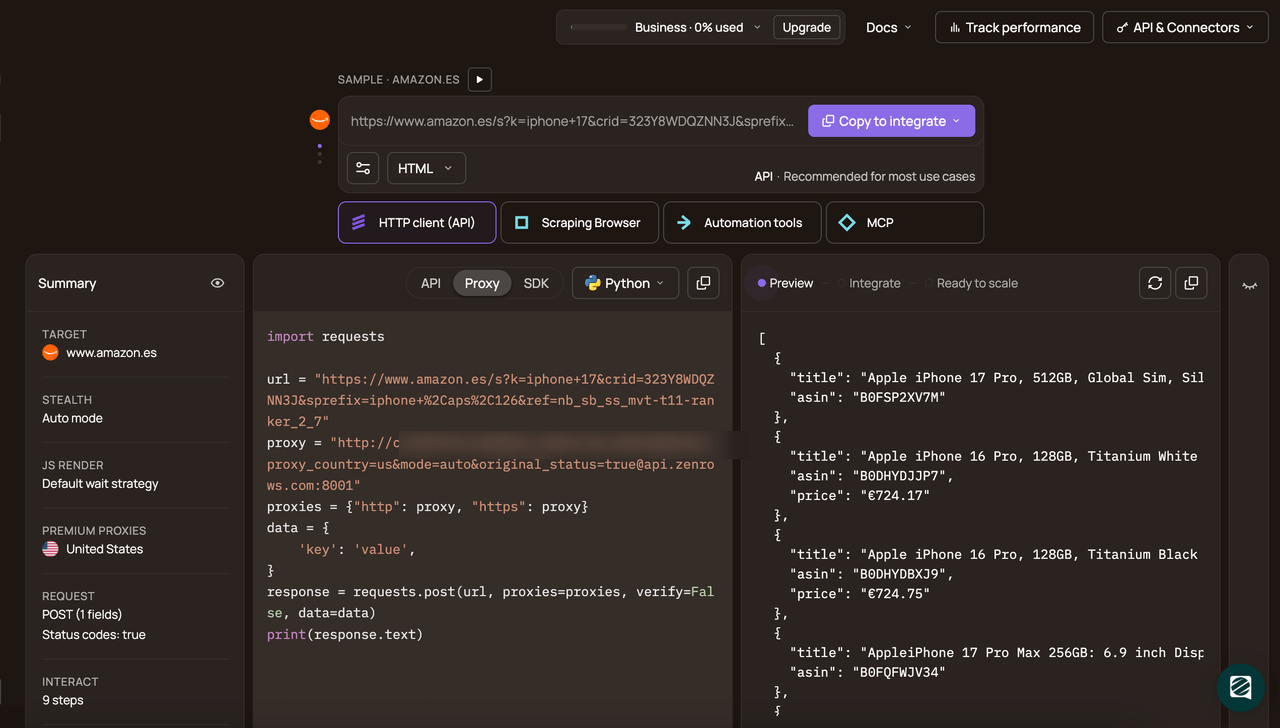
In your codebase, simply add mode=auto to your request parameters. No more js_render and premium_proxy:
# pip3 install requests
import requests

url = "https://www.scrapingcourse.com/ecommerce/"
apikey = "<YOUR_ZENROWS_API_KEY>"
params = {
    "url": url,
    "apikey": apikey,
    "mode": "auto",
}
response = requests.get("https://api.zenrows.com/v1/", params=params)
print(response.text)
Let's handle the configs for you. Try our Adaptive Stealth Mode now!
FAQ
Why should I use the Adaptive Stealth Mode?
Adaptive Stealth Mode takes the guesswork out of scraping. It automatically tests, learns, and applies the optimal strategy for each target website, giving you higher success rates and faster results without manual configuration. You save time, reduce costs, and avoid frustrating failures, letting you focus on getting the data you need.
Does the Adaptive Stealth Mode attract extra cost?
No, Adaptive Stealth Mode doesn’t add any extra fees. In fact, it often reduces your overall cost by starting with the most efficient and cost-effective approach and only escalating to advanced configurations when needed. You get smarter scraping and more savings, all included with your Zenrows plan.
How does Adaptive Stealth Mode handle completely new websites?
When scraping a new website, Adaptive Stealth Mode starts with the most cost-effective, basic configuration. If that doesn’t succeed, it seamlessly escalates to more advanced methods until it finds a solution. All of this happens automatically in the background.
Once ASM identifies the successful approach, it saves that configuration for future requests and adapts as new success criteria emerge. You simply send a single request and receive results; Adaptive Stealth Mode takes care of the trial-and-error, ensuring every subsequent scrape is faster and more efficient.
Do I still need a custom retry logic with Adaptive Stealth Mode?
No, you don’t need custom retry logic. Adaptive Stealth Mode automatically handles retries, adapting its approach whenever a request fails. It tests alternatives and escalates as needed until it succeeds, so you can focus on getting results without worrying about manual retries.
Does Adaptive Stealth Mode reduce latency?
Yes, Adaptive Stealth Mode can help reduce latency. Since it remembers the optimal scraping configuration for each website, it avoids unnecessary trial-and-error and escalations, making future requests faster. You get quicker results, especially for sites you scrape repeatedly, thanks to its adaptive learning and smart strategy selection.
Does Adaptive Stealth Mode handle automatic parsing?
No, Adaptive Stealth Mode only focuses on ensuring your request succeeds at the lowest cost possible and doesn't handle automatic parsing. For parsing, use the auto-parse feature for supported websites or include specific selectors in your request using the css_extractor parameter.
Will I get low success rates if I don't use Adaptive Stealth Mode?
Without Adaptive Stealth Mode, your scraping requests rely on manual setup and static configurations, which may not work for every website, especially those with strong protections. This often leads to more failed attempts and lower overall success rates. Adaptive Stealth Mode eliminates this guesswork by automatically identifying and applying the most effective strategy for each site, so you consistently achieve higher success and reliability at the lowest possible cost.