
Best Bright Data Alternative for Self-Service Scraping
Looking for the best Bright Data alternative? Compare Zenrows vs. Bright Data on pricing, anti-bot performance, features, and real benchmark results.


Zenrows is the best Bright Data alternative for developers and small- to mid-market teams that need reliable anti-bot bypass without Bright Data's $499-per-product commitments, KYC requirements, and multi-product billing complexity.
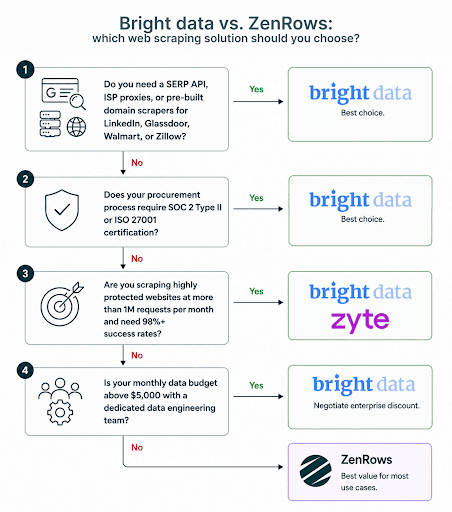
Bright Data is the enterprise benchmark in this category. Its 150 million+ residential IPs across 195 countries, SOC 2 Type II and ISO 27001 certifications, and a 99.99% uptime SLA reflect an infrastructure built for enterprise procurement teams with five-figure monthly budgets and dedicated data-engineering staff. If your procurement requires those certifications, or your workload depends on Bright Data's SERP API, ISP proxies, or 437+ pre-built domain scrapers, Bright Data is the right choice. This article is for everyone else.
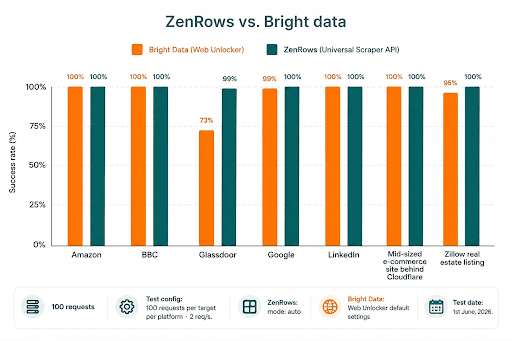
To ensure you make the right decision, we ran our own tests across seven targets, with 100 requests per target, 2 requests per second. Zenrows averaged 99.85%. Bright Data averaged 95.28% and returned 100% across all seven targets, except for Glassdoor, Google, and Zillow, which is consistent with independent benchmarks. For most targets, Zenrows matched Bright Data at 100%.
If you want a quick side-by-side before diving in, our Bright Data vs. Zenrows comparison page has you covered.
Skip the blocks. Try Zenrows free and get clean web data without the anti-bot fight.
Zenrows vs. Bright Data at a Glance
Here is the comparison table for Zenrows and Bright Data.
| Criteria | Zenrows | Bright Data |
|---|---|---|
| Success rate, our test (1st June 2026, 7 targets, and 100 runs) | 99.85% | 95.28% |
| Avg. response time, our test | 10.0 s | 10.6 s |
| Effective cost / 1,000 protected requests | $7.00 | $1.50 |
| Residential IP pool | 55M+ IPs across 190+ countries | 150M+ IPs across 195 countries |
| Entry price (all-products stack) | $69/month (single plan with shared balance) | $499/month per product ($1,497/month for the 3 products) and no shared balance |
| Products on one bill | Yes | No |
| Success-billed only (no exceptions) | Yes | No (requests with custom headers/cookies are billed per request) |
| KYC required for full access | No | Yes |
| Self-service signup | Yes | No (KYC is required) |
| Free trial | Yes, 1,000 URLs and no credit card required | Yes, $25–$50 in credits after KYC |
| SERP API coverage | No | Yes |
| Compliance certification (SOC 2 Type II / ISO 27001) | No | Yes (both) |
Since you have a quick overview, let's briefly mention how we ran our test and benchmarked Bright Data and Zenrows.
How We Tested
We benchmarked Bright Data and Zenrows on 1st June 2026 against seven target sites with different protection levels and page complexity:
We benchmarked Bright Data and Zenrows on 1st June 2026 against seven target sites with different protection levels and page complexity:
- Amazon product page (protected, Kasada/custom)
- Glassdoor company page: Google (protected, DataDome)
- LinkedIn: Satya Nadella (protected)
- Google SERP result page
- Ikea.com (mid-sized e-commerce site protected by Cloudflare)
- Zillow real estate listing (unprotected)
- BBC news article (unprotected)
Each target received 100 requests at a concurrency of 2 requests/second, measuring HTTP 200 success rate, response time, and the presence of a valid page title in the HTML results. For Zenrows, we used Fetch with mode=auto.
For Bright Data, we used Web Unlocker with the default settings. This test does not cover Zenrows Scraping Browser. It also doesn't cover Bright Data's SERP API, ISP and mobile proxies, and pre-built domain-specific scrapers, because Zenrows has no equivalent. Zenrows' equivalent of the pre-built domain-specific scrapers, however, it is still in beta. We were also unable to work with Bright Data's enterprise plan features (dedicated IPs, account management, SLA).
Check out the GitHub repository for the full test scripts and data.
To calculate our success rate, we used the percentage of requests that returned HTTP 200 with a valid page title across all seven targets. This is our primary criterion.
The sections below detail how Zenrows and Firecrawl performed in the test and break down how they differ across cost, setup complexity, and long-term maintenance.
Zenrows
Details
Zenrows is a web scraping API that handles browser rendering, proxy rotation, CAPTCHA solving, and anti-bot bypass behind a single endpoint. For this test, we used Fetch on the Developer plan at $69 per month, with Adaptive Stealth Mode (mode=auto) enabled.
Testing with Amazon
Result: 100% success rate
Response time: 16.84s
Testing with Glassdoor
Result: 99.0% success rate
Response time: 8.67s
Testing with LinkedIn public profile page
Result: 100% success rate
Response time: 22.36s
Testing with Google SERP
Result: 100% success rate
Response time: 21.42s
Testing with Ikea.com
Result: 100% success rate
Response time: 2.59s
Testing with Zillow real estate listing
Result: 100% success rate
Response time: 11.20s
Testing with BBC news article
Result: 100% success rate
Response time: 2.26s
Test summary
Zenrows averaged 99.85% across all seven targets, with an average total response time of 11.86s. It was fastest on BBC and Ikea.com and strongest on Glassdoor among protected sites at 99%. The 99.85% figure covers all seven targets, including the two unprotected sites.
Bright Data
Details
Bright Data is a web data infrastructure platform that provides users with a suite of products, including proxy networks, Web Unlocker API, Scraping Browser, pre-built domain scrapers, and a SERP API. For this test, we used the Web Unlocker endpoint with default settings, no custom headers, and no cookie injection.
Testing with Amazon
Result: 100% success rate
Response time: 8.92s
Testing with Glassdoor
Result: 73% success rate
Response time: 31.08s
Testing with LinkedIn public profile page
Result: 100% success rate
Response time: 18.62s
Testing with Google SERP
Result: 99% success rate
Response time: 4.38s
Testing with Ikea.com
Result: 100% success rate
Response time: 6.24s
Testing with Zillow real estate listing
Result: 95% success rate
Response time: 13.52s
Testing with BBC news article
Result: 100% success rate
Response time: 4.21ms
Test summary
Bright Data averaged 95.28% across all seven targets, with an average total response time of 10.77s. It was fastest on Amazon (a protected site).
Speed Comparison
Zenrows had an average response time of 11.86s across all seven targets, while Bright Data had 10.77s. The table below shows the average response time for each target.
| Target site | Zenrows average response time (s) | Bright Data average response time (s) |
|---|---|---|
| Amazon product page (protected, Kasada/custom) | 16.84 | 2.89 |
| Glassdoor company page (protected, DataDome) | 8.67 | 31.08 |
| LinkedIn public profile page (protected, very hard) | 22.36 | 18.62 |
| Google SERP | 21.42 | 4.38 |
| Ikea.com | 2.59 | 6.24 |
| Zillow real estate listing | 11.20 | 13.52 |
| BBC news article | 2.26 | 4.20 |
| Average | 11.86 | 10.77 |
Price Comparison
For the 700 requests in our test, Zenrows costs $2.34 in total. Bright Data costs about $1.08 per target. However, these numbers come with one caveat worth noting up front: both accounts were on entry-level plans; Zenrows Developer at $69/month and Bright Data on a promotional trial credit. Per-request costs shift meaningfully as you scale up or commit to higher tiers, and the all-in monthly stack tells a different story than cost-per-request alone. We break down the full pricing math as you read further in this article.
Final Verdict
Zenrows is the right choice for most self-service scraping workloads. In our test across seven targets, it matched Bright Data on six of them, for example, hitting 99% on Glassdoor, where Bright Data dropped to 73%, 100% on Zillow against Bright Data's 95%. It also matches Bright Data's 100% on both BBC and the Cloudflare e-commerce target.
In terms of response time, the gap is narrow: 11.9s for Zenrows versus 10.8s for Bright Data. At $299/month (Business plan) all-in versus $1,497/month across three Bright Data-committed zones, Zenrows delivers comparable or better results for the majority of production targets at one-fifth the cost.
Choose Bright Data when your pipeline depends on Google SERP data at scale, when your targets include the hardest-defended sites on the internet, or when your procurement requires SOC 2 Type II and ISO 27001. Those are the only three conditions where Bright Data's infrastructure advantage justifies the price. For everything else, Zenrows wins on both performance and economics.
Let's explore why you might need an alternative to Bright Data.
Why Developers Look for Bright Data Alternatives in 2026
Three friction points come up consistently when developers start evaluating alternatives.
1. The $499 per-product commitment
A production Bright Data stack covering Web Unlocker, Scraping Browser, and Residential Proxies requires three separate $499 per-product commitment plan entries. That is $1,497 per month before a single request is tuned, with no shared balance across products. Running out of budget on one product does not transfer credit to another.
2. Billing-mode switching in custom configurations
Bright Data's Web Unlocker is success-billed by default. Enabling custom headers or cookies silently switches the billing mode to all-request, meaning failed requests, challenge pages, and retries all count toward your bill. Developers who configure custom parameters for specific targets often discover this on their invoice rather than in the documentation.
3. KYC onboarding for residential and browser access
Full access to Bright Data's Residential and Browser APIs requires KYC verification, which is restricted to registered companies. Individual developers and unincorporated teams cannot complete the process. A Trustpilot reviewer described the experience as discovering that the platform was "effectively unusable for private individuals" only after signing up and encountering errors. Immediate Access, the workaround Bright Data offers, is restricted to GET-only requests on approximately 200 pre-approved domains as of April 2026.
Two product-level changes in April 2026 have added further evaluation pressure. Bright Data updated its account management policy, which affected access conditions for certain products. It also discontinued mobile proxies for new customers in the same month. Teams that had priced mobile proxy access into their infrastructure planning discovered this mid-evaluation. Confirm the current availability of any specific product on Bright Data's site before committing.
What Bright Data Actually Costs vs. What You Think It Costs
The $499 per month figure on Bright Data's pricing page covers one product. A production stack covering Web Unlocker, Scraping Browser, and Residential Proxies requires three separate committed-plan entries at $499 each. The all-in entry cost is $1,497 per month before a single request is tuned. There is no shared balance across products. If Web Unlocker's budget runs out mid-month, the Scraping Browser balance does not cover the shortfall.
Zenrows' Business plan at $299 per month covers all three equivalent products on a single shared balanced system. Spend $150 on Fetch and $149 on the Scraping Browser, and the total is $299, one invoice, one dashboard, no allocation required between products.
The billing-mode difference compounds this gap on failure-heavy workloads. At 100,000 requests with a 30% failure rate, success-only billing costs $91 at Bright Data's $1.30 per 1,000 committed rate, covering the 70,000 successful requests. All-request billing on the same job costs $130, covering all 100,000 requests, including the 30,000 that returned challenge pages or failed. That $39 difference scales with volume and failure rate. Zenrows charges zero on failed requests with no exception for custom configurations.
One place Bright Data's pricing genuinely wins is at one million+ protected requests per month on a single product. Bright Data's committed rate of approximately $1 per 1,000 is below Zenrows' $2 per 1,000 at the Business 2k tier. If your workload reaches that volume on a single product and you can absorb the per-product commitment structure, Bright Data is cheaper at scale. One additional cost variable worth flagging before you plan your budget is Bright Data's RESIGB50 promotional rate, which charges $4 per GB for residential traffic. The steady-state PAYG rate is $8 per GB. The promotion expires after three months. Teams that model their infrastructure cost around the promotional rate face a billing change at month four.
The table below compares Bright Data's three-product stack with Zenrows' shared balance plan so you can see the cost and billing difference at a glance.
| Cost variable | Bright Data | Zenrows |
|---|---|---|
| Product covered | Web Unlocker, Scraping Browser, and Residential Proxies | Fetch, Scraping Browser, and Residential Proxies |
| Monthly cost | $499 × 3 products ($1,497/month, separate commitments) | $299/month (shared balance) |
| Billing model | Success-billed except when custom header/cookie-enabled scraping is enabled | Always success-billed |
| Minimum commitment | $499/month per product | $69/month (Developer plan) |
| Separate dashboard required | Products are managed independently | Single dashboard |
Why Zenrows Is the Best Bright Data Alternative for Self-Service Teams
Zenrows' Fetch, Scraping Browser, and Residential Proxies all run on a single shared balance with no product-level zones to configure and no separate dashboards to manage. For a developer coming off Bright Data's three-product architecture, that consolidation removes a meaningful amount of ongoing operational overhead.
The billing model reflects the same principle. Every request is charged only on success, with no exception for custom headers, cookies, or advanced configurations. Failed requests, challenge-page responses, and retries cost zero. That rule does not change based on what parameters you pass.
On anti-bot coverage, Zenrows handles Cloudflare, DataDome, PerimeterX, Akamai, Kasada, CAPTCHA solving, JavaScript rendering, residential proxy rotation, and Adaptive Stealth Mode across a network of 55 million+ residential IPs in 190+ countries. Bright Data's network is larger, with 150 million+ IPs across 195 countries. That gap matters on the narrowest targeting requirements, specific ASN-level routing, or ZIP-code coverage in certain geographies. For the majority of production scraping workloads, both networks produce comparable success rates on standard protected targets.
Migration from Bright Data to Zenrows is an endpoint swap and an authentication change. Your scraping logic, target URLs, parsers, and output handling stay the same. The code blocks below show the same request on both platforms.
Example
import requests

bd = requests.post(
    "https://api.brightdata.com/request",
    headers={"Authorization": f"Bearer {YOUR_BRIGHTDATA_API_KEY}"},
    json={
        "zone": "unblocker",
        "url": "https://www.bbc.com/news/technology",
        "format": "raw"
    }
)

print(f"Bright Data | status: {bd.status_code} | bytes: {len(bd.text)}")
print(bd.text[:300])
Copied!
The code below shows how to call Zenrows' Fetch as a GET request, pass the target URL, and use mode=auto to inspect the target and escalate to JS rendering or premium proxies only if needed.
Example
import requests

zr = requests.get(
    "https://api.zenrows.com/v1/",
    params={
        "apikey": YOUR_ZENROWS_API_KEY,
        "url": "https://www.bbc.com/news/technology",
        "mode": "auto"
    }
)

print(f"ZenRows    | status: {zr.status_code} | bytes: {len(zr.text)}")
print(zr.text[:300])
print("-" * 60)
Copied!
This code shows how both send a target URL to their respective scraping APIs and retrieve the output. The difference is just how they do it. Below is the output for both tools:
Output
ZenRows    | status: 200 | bytes: 448703
<!DOCTYPE html><html lang="en-GB"><head><meta charSet="utf-8" data-next-head=""/><meta name="viewport" content="width=device-width" data-next-head=""/><title data-next-head="">BBC Technology | Technology, Health, Environment, AI</title><meta name="page.section" content="Technology" data-next-head=""
------------------------------------------------------------

Bright Data | status: 200 | bytes: 448703
<!DOCTYPE html><html lang="en-GB"><head><meta charSet="utf-8" data-next-head=""/><meta name="viewport" content="width=device-width" data-next-head=""/><title data-next-head="">BBC Technology | Technology, Health, Environment, AI</title><meta name="page.section" content="Technology" data-next-head=""
Copied!
Anti-Bot Performance: Zenrows vs. Bright Data Tested
Before the original test results, the independent benchmark context is worth establishing.
Scrape's 2026 benchmark across seven protected domains put Bright Data at an average success rate of 98.87% and Zenrows at 96.29%. Bright Data hit 100% on Indeed, Zillow, Google, and GitHub, with 80% on Capterra, 96.7% on both X (Twitter) and Amazon. Zenrows reached 100% across all targets except Amazon, which returned 74%. Proxyway's 2025 benchmark across 15 heavily protected sites at 2 req/s put Zenrows at 70.39%. Both benchmarks reflect the same pattern: Bright Data leads on the hardest targets, and the gap widens as target difficulty increases.
In our test, we used Zenrows' Fetch with mode=auto and Bright Data's Web Unlocker with default settings across seven targets, each with 100 requests at 2 req/s.
Check out the GitHub repository for the full test scripts and data.
| Target site | Zenrows success rate | Bright Data success rate |
|---|---|---|
| Amazon product page (protected, Kasada/custom) | 100% | 100% |
| Glassdoor company page (protected, DataDome) | 99.0% | 73% |
| LinkedIn public profile page (protected, very hard) | 100% | 100% |
| Google SERP | 100% | 99% |
| Ikea.com | 100% | 100% |
| Zillow real estate listing | 100% | 95% |
| BBC news article | 100% | 100% |
| Average | 99.85% | 95.28% |
Bright Data returned 100% across all seven targets except Glassdoor, Google, and Zillow, which is consistent with its independent benchmark position. Zenrows averaged 99.95%, with Glassdoor returning 99%. On every other target, Zenrows matched Bright Data at 100%.
On response time, Zenrows averaged 11.86s across all targets. Bright Data averaged 10.77s on the same set. The difference is within the normal range of variance for protected-site requests and does not reflect a meaningful operational gap for most scraping workloads.
Is Bright Data Worth It for Small Teams?
Bright Data is worth it for small teams in four specific situations.
- Your procurement requires SOC 2 Type II or ISO 27001 certification from data vendors.
- Your workload depends on Bright Data's SERP API for Google, Bing, Yandex, or Baidu.
- You need pre-built domain scrapers for LinkedIn, Glassdoor, Walmart, or Zillow from Bright Data's 437+ scraper library.
- Your targets are hardened enough that Bright Data's 150 million+ IP pool and ASN-level geo-targeting are one of the few infrastructures that produces the success rate you need.
Outside those four conditions, the mismatch is in product rather than in product quality. Standard production targets, job boards, real estate listings, e-commerce sites, and Google SERPs behind Cloudflare or DataDome do not require the infrastructure Bright Data is built for. A developer team of one to ten without a dedicated data-engineering function will absorb the per-product commitment and configuration overhead without receiving proportional value in return.
This is not a theoretical concern. A Software Advice review that had used both tools chose Zenrows over Bright Data. They reported: "Bright Data has extensive functionality, We also use BrightData. It has a lot of functionality, but its high fees and complexity of configuration were a problem for us. In particular, it was not flexible in its configuration with respect to JS rendering, which often meant that data could not be retrieved. Zenrows eliminated all of these problems. I look forward to more feature updates in the future. The configuration complexity was the deciding factor, not the performance."
When Bright Data Is Still the Right Choice
There are four situations in which Bright Data is the right call, regardless of the price difference.
- You need a SERP API, ISP proxies, or pre-built domain scrapers: Bright Data's SERP API returns structured results across Google, Bing, Yandex, and Baidu with geo-level control. Its library of 437 + pre-built domain scrapers covers LinkedIn, Glassdoor, Walmart, Zillow, and hundreds of other specific targets. Its dataset marketplace provides ready-to-use structured data without needing to run a scraper at all. Zenrows has none of these. If any of them are requirements, Bright Data is the answer.
- Your procurement requires SOC 2 Type II or ISO 27001 certification: Bright Data holds both, publishes a Trust Center, and commits to a 99.99% uptime SLA. Zenrows does not currently publish equivalent compliance attestations. For regulated industries or enterprise procurement teams with vendor certification requirements, this is a hard gate.
- You scrape the hardest WAF-protected targets at production volume and need 98% or more success: Sites running custom Kasada configurations, Shein, G2, Hyatt, and similarly hardened targets at more than one million requests per month sit at the edge of what most tools handle reliably. Bright Data's 150 million+ IP pool and independent benchmark position of 98.87% reflect infrastructure built specifically for that workload. Zyte at 93.14% on Proxyway's 2025 benchmark is the other option worth evaluating at this tier.
- Your monthly data budget is above $5,000 with a dedicated data-engineering team: At that scale and with negotiating leverage, Bright Data's enterprise discount range of 25 to 40 percent off list price can bring the per-request cost below Zenrows' protected-request rates on a single product. Without a dedicated team to manage the configuration overhead, the operational cost offsets the pricing advantage.
Other Bright Data Alternatives Worth Knowing
Besides Bright Data and Zenrows, there are several other scraping tools out there, depending on your use cases. These tools, while great, come with some trade-offs. Let's take a look at them.
- Oxylabs: The closest enterprise alternative to Bright Data on proxy infrastructure, with 175 million + residential IPs across 195 countries, and its own SERP Scraper API. The 2026 product line adds AI-Crawler, AI-Scraper, and Browser Agent. Proxyway's 2025 benchmark puts Oxylabs at an 85.82% success across 15 heavily protected sites, between Zenrows and Bright Data. The entry price is comparable to Bright Data's. Right for enterprise teams that want Bright Data-scale infrastructure without a Bright Data-specific vendor relationship.
- Zyte: The highest independent benchmark success rate among scraping APIs at 93.14% across 15 protected sites in Proxyway's 2025 report. The trade-off is pricing predictability. Zyte auto-assigns your domain to one of five tiers after your first request, and the assignment is reviewed quarterly with two weeks' notice. Browser-rendered pages can reach $16.08 per 1,000 requests on PAYG. Right for teams that need maximum protected-site success rate and can tolerate that pricing structure.
- ScraperAPI: The self-service option for teams scraping Amazon, Google SERP, or Walmart at volume with no KYC and no sales call. Entry at $49 per month. Proxyway 2025 reports a success rate of 68.95% for heavily protected sites. Country-level geo-targeting is available only with the Business plan at $299 per month. Right for budget-conscious teams on standard e-commerce and SERP targets.
- Scrapfly: Consistently the highest success rate in Scrapeway's rolling benchmark at approximately 99% average across protected targets. Entry at $30 per month. Right for teams that need top-tier protected-site success among self-service tools and are comfortable with a smaller proxy network than Bright Data or Oxylabs.
- Decodo (formerly Smartproxy): The right choice when the bottleneck is residential proxy quality rather than the scraping API layer. Proxyway's 2025 benchmark places Decodo at 87.09% success with 0.54 second latency, the fastest response time among all providers tested. Its network covers 115+ million IP addresses across 195+ countries at $2 per GB, with a $75 per month entry plan for the proxy side and a separate Web Unblocker API. Right for teams that need Bright Data-level proxy bandwidth at a lower per-GB rate without Bright Data's SERP or dataset products.
| Capability | Bright Data | Zenrows | Oxylabs | Zyte | ScraperAPI | Scrapfly | Decodo |
|---|---|---|---|---|---|---|---|
| Best for | Enterprise teams with compliance and multi-product needs | Anti-bot reliability at predictable cost | Enterprise teams that want Bright Data–level scale with self-service tooling | Python and Scrapy teams | Developers scraping on a budget | Small technical teams needing top-tier capabilities at competitive rates | Teams that have a scraper but need proxy infrastructure |
| Anti-bot success rate (protected sites) | 98.87% (Scrape 2026) | 96.29% (Scrape 2026) | 99.94% (Proxyway 2025) | 93.14% (Proxyway 2025) | 68.96% (Proxyway 2025) | 99% (Scrapeway May 2026) | 99.86% (Proxyway 2025) |
| Residential IP pool | 150M+ IPs across 195 countries | 55M+ IPs across 190+ countries | 175M+ IPs across 195 countries | Not publicly disclosed | 72M+ IPs across 70+ countries | Not publicly disclosed | 115M+ IPs across 195 countries |
| Entry price (all-products stack) | $499/month per product ($1,497/month for all 3 products) | $69/month (Developer plan) | $49/month (Web Scraper API) | $100/month | $49/month | $30/month | $75/month |
| Products on one bill | No | Yes | No | Yes | Yes | Yes | No |
| Success-billed only (no exceptions) | No (requests with custom headers are billed) | Yes | Yes | Yes | No | Yes | No |
| KYC required for full access | Yes | No | Yes (for restricted targets) | No | No | No | No |
| Self-service signup | No (KYC required for full access) | Yes | No (some products require contacting sales) | Yes | Yes | Yes | Yes |
| SERP API | Yes | No | Yes | No | No | No | Yes |
| SOC 2 Type II / ISO 27001 | Yes (both) | No | No | No | No | No | No |
Frequent Questions
What is the best alternative to Bright Data for web scraping?
For developers and small- to mid-market teams, Zenrows is the strongest alternative because it includes all features in a single plan. However, for an enterprise, Oxylabs would be the closest alternative to Bright Data, as it offers compliance certifications and a prebuilt domain scraper.
Does Bright Data still offer mobile proxies in 2026?
Bright Data Mobile proxy was discontinued for new and existing accounts as of April 2026. However, there was no official blog post or release note from the team. A Reddit trend and this breakdown by illustory talks more about it.
What is cheaper than Bright Data for SERP data?
Decodo offers pay-as-you-go pricing starting at $0.08/1K requests. That is lower than Bright Data's SERP API at $1.50/1K PAYG or $1.30/1k on one of their committed tier.
Is there a free alternative to Bright Data?
There is no fully free Bright Data alternative for production use, but Zenrows offers a free tier with 1,000 free requests for testing. The free trial doesn't require a credit card.
Is Bright Data worth it for small teams?
Yes, but only in specific cases: when compliance certifications are required, when you need structured SERP data, or need targets from one of Bright Data's 150 million+ IPs with ASN-level targeting.
Will I lose capability by switching from Bright Data to Zenrows?
Yes, you lose access to Bright Data's resources, including its certification coverage and product-specific features. But for many standard scraping workloads, the migration is functionally straightforward.
What's the real all-in cost difference between Bright Data and Zenrows?
Bright Data's scraping landscape (Web Unlocker, Scraping Browser, and Residential Proxies) costs about $1,497/month. Zenrows' Business plan covers all three tools for $299/month, with a single shared balance.
How long does the switch from Bright Data to Zenrows actually take?
Less than an hour because migrating only requires an endpoint change and an authentication change. Bright Data's Web Unlocker uses a POST pi.brightdata.com/request with a Bearer token and zone name; Zenrows uses a GET to api.zenrows.com/v1/