
Best Zyte Alternatives for Anti-Bot Scraping
Compare the best Zyte alternatives for web scraping. See benchmark results, pricing, anti-bot performance, and the top tools for protected sites.


Zenrows is the best Zyte alternative for developers who need reliable anti-bot bypass with a bill they can model before a job runs.
However, Zyte has also earned its reputation. In Proxyway's 2025 Web Scraping API Report, the most rigorous independent benchmark the industry has right now, Zyte led the field at 93.14% success across 15 heavily protected sites at production concurrency. If raw success rate were the only criterion, this article would be one sentence long.
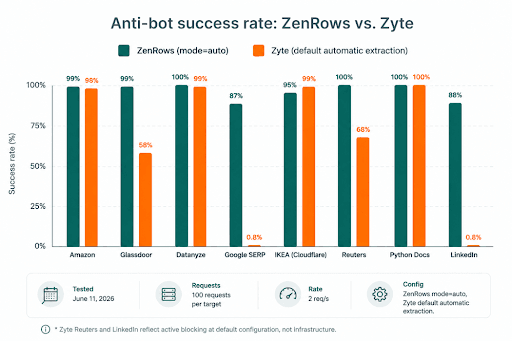
The question this article answers is different: which tool lets you run a predictable web scraping pipeline without a pricing model that can shift 123x between your best and worst case? We tested both against eight targets at 100 requests per target on June 11, 2026. Zenrows won six of the eight targets with a 96% average. Full results in the Anti-Bot Performance section below.
Beyond Zenrows, this piece covers six alternatives for specific use cases: Apify for Scrapy Cloud migrators, Bright Data when failure is not an option, Firecrawl when the output feeds an LLM, ScraperAPI for flat-rate SERP and e-commerce scraping, ScrapingBee as the closest budget alternative, and Oxylabs when proxy quality is the bottleneck.
Skip the blocks. Try Zenrows free and get clean web data without the anti-bot fight.
Zenrows vs. Zyte at a Glance
How to read this table: Success rates come from two different benchmarks.
Our test used eight targets at 100 requests each, tested June 11, 2026, at 2 req/s. Proxyway 2025 used 15 heavily protected sites at 2 req/s. Cost per 1,000 protected requests reflects Zenrows' 25x multiplier from test data and Zyte's auto-assigned Tier 5 range. Protected means targets actively running Cloudflare, DataDome, or PerimeterX.
| Metric / Feature | Zenrows | Zyte |
|---|---|---|
| Anti-bot success rate (our test, 8 targets, Jun 11 2026) | Won on 6 of 8 targets: 99% Amazon, 99% Glassdoor, 100% Datanyze, 87% Google SERP, 100% Reuters, 88% LinkedIn. 96% overall | Lost on 6 of 8 targets: 0% Google SERP, 58% Glassdoor, 68% Reuters, 0% LinkedIn. 65.3% overall (wins on IKEA 99%, Python Docs 100%) |
| Avg. response time (our test) | 17.5s overall (faster on Datanyze 5.1s, Python Docs 2.1s) | 10.1s overall (faster on Google SERP 1.6s, LinkedIn 2.5s) |
| Effective cost per 1,000 protected requests | Fixed. $7.00 (25× multiplier, known upfront) | Variable. $1.01–$16.08 (auto-assigned tier, reviewed quarterly) |
| Pricing model | Credit multiplier (1× to 25× based on features used) | Auto-assigned domain tiers (Tier 1–5, HTTP or browser) |
| Pricing predictability | Transparent, full pricing on website, no sales call | Opaque until first request lands; 123× range between tiers |
| Self-service signup | Yes, instant | Yes |
| Free trial | Yes (1,000 free API credits) | Yes |
| Pay-only-for-success | Yes (failed requests not billed) | No |
| Country-level geo on entry plan | Yes (190+ countries on Developer Plan) | Limited to lower tiers |
| Support response time SLA | Chat and AI support on all plans; priority from Business | Ticketed, no published SLA below Enterprise |
| Anti-bot success rate (Proxyway 2025, external benchmark, 15 protected sites) | 70.39% at 2 req/s | 93.14% at 2 req/s (15 hardest WAF-protected enterprise targets only) |
Why Developers Are Looking for Zyte Alternatives In 2026
Three patterns show up consistently when developers start evaluating alternatives.
Pricing predictability: Zyte automatically assigns your domain to one of five pricing tiers after your first request lands. That assignment is reviewed quarterly, and if it changes, you get two weeks’ notice. The cost range between Tier 1 HTTP at $0.13 per thousand requests and Tier 5 browser-rendered at $16.08 is 123x. For teams running high-volume data pipelines, that range makes monthly cost forecasting genuinely difficult. One G2 reviewer puts it plainly: “The pricing structure could be more transparent for me — I initially underestimated the cost at scale.”
Support response time: On standard plans, Zyte operates on a ticketed support model with no published response time SLA below the Enterprise tier. A Trustpilot reviewer noted: "One response every 24-48 hours and nothing on a weekend is not good enough if you have a commercial application relying on the data you are scraping". For a production pipeline, the gap between when something breaks and when you get an answer is an operational risk, regardless of which tool caused it.
Runtime fit: Scrapy Cloud is purpose-built for Scrapy-native teams. Developers who want a straightforward REST API to collect web data without adopting Scrapy's deployment model and conventions have started looking for alternatives, and the options available in 2026 are meaningfully better than they were two years ago.
None of this is a verdict on Zyte’s core product. It is the context for why the alternatives in this article exist and who they are built for.
Why Zenrows Is the Best Zyte Alternative for Predictable Anti-Bot Scraping
The pricing case is straightforward once you look at actual numbers. On the Developer plan at $69 a month, you’re paying $7.00 per 1,000 protected requests across a 10,000-request allowance (and you know that before you write a single line of code).
Step up to Startup at $129 a month, and that protected rate drops to $3.25 per 1,000. At Business ($299 a month), you’re at $2.50 per 1,000 with 120,000 requests included. Run a million mixed requests a month on the Business 1K plan at $999, and your basic rate bottoms out at $0.08 per 1,000.
Compare that to Zyte, where a domain you expected to land on Tier 1 HTTP at $0.13 per 1,000 can auto-assign to Tier 4 browser-rendered at $9.60 (reviewed quarterly with two weeks’ notice). One model lets you budget in Google Sheets. The other makes budgeting genuinely difficult.
But predictable pricing only matters if the tool can actually get through the door. Zenrows’ anti-bot protection runs on AI-powered fingerprint management and residential proxy rotation broad enough that most teams won’t hit its ceiling. Cloudflare, DataDome, PerimeterX, Akamai, and CAPTCHA challenges are all handled automatically behind a single endpoint. The part worth paying attention to is Adaptive Stealth Mode (mode=auto). It starts every request at the cheapest possible configuration and only escalates infrastructure when the target demands it.
That means you’re not burning the 25-credit premium on every request but only on the ones that earn it. Underneath all of this sits a 55 million IP residential network across 190+ countries, available on every plan tier.
Two more things close the gap with Zyte for most workloads. Auto-parse returns structured data in JSON format on supported e-commerce and SERP targets, eliminating the need to extract data through custom selector logic you’d otherwise maintain yourself. And Zenrows only charges for successful responses. Failed requests and retries don’t touch your balance, which means your effective cost per useful result is lower than the headline rate suggests.
If your team already runs Puppeteer or Playwright scripts, the Scraping Browser removes the last reason to manage local browser infrastructure. It’s a cloud-hosted headless browser over a single WebSocket connection. For instance, you can swap your local browser endpoint for the Zenrows WebSocket URL, and your existing browser automation runs unchanged. Proxy rotation, fingerprint management, and CAPTCHA handling all shift to Zenrows’ infrastructure. One line of code and you’re done maintaining browser instances.
That said, if you need 95%+ success on the hardest protected targets like Shein, Walmart, or G2, the Proxyway 2025 benchmark puts Zenrows at 70.39% on the 15 hardest WAF-protected sites, against Zyte's 93.14%.
In our own tests, Zenrows returned 88% on LinkedIn against Zyte's 0%, which is a strong result on one of the hardest targets in the field. But if your pipeline depends on scraping the absolute hardest 5% of the web at production volume and cannot tolerate a sub-90% success rate, Zyte or Bright Data is the stronger choice.
How We Tested
Tests were conducted on June 11, 2026 at 2 req/s sequential concurrency, 100 requests per target. Full test script available at GitHub.
Zenrows:
mode=autoon the Developer planZyte: default automatic extraction endpoint, no manual tier overrides
Targets tested: Amazon, Glassdoor, Datanyze, Google SERP, IKEA, Reuters, Python Docs, LinkedIn
Zenrows
Plan tested: Developer ($69/month)
Configuration: mode=auto (Adaptive Stealth, starts cheap, escalates only if needed)
Free trial: 1,000 free API credits, no credit card required Pricing: $0.28 per 1,000 basic requests; up to $7.00 per 1,000 at 25x multiplier (JS rendering + premium proxies)
Pay-only-for-success: Yes, failed requests are not billed
Getting to your first request
Zenrows gets you to a working request in under five minutes. After adding your API key, your first scraper looks like this:
Example
import requests

url = "https://www.amazon.com/dp/B09B8YWXDF"
api_key = "YOUR_ZENROWS_API_KEY"

response = requests.get(
    "https://api.zenrows.com/v1/",
    params={
        "url": url,
        "apikey": api_key,
        "mode": "auto",  #Adaptive Stealth: starts cheap, escalates only if needed
    },
)

print(response.status_code)
print(response.text[:500])
Copied!
Testing with Amazon
Result: 99% success rate | Avg. response time: 22.5s
Zenrows returned 99% on Amazon across all 100 requests, with one connection error. Amazon runs Cloudflare and behavioral detection; mode=auto handled it without manual configuration, though response times are higher than Zyte on this target.
Testing with Glassdoor
Result: 99% success rate | Avg. response time: 20.4s
Glassdoor uses DataDome, one of the stricter bot-management layers in the field. Zenrows returned 99% success across all 100 requests. DataDome triggers more infrastructure escalation, which explains the slower response time, but the success rate holds.
Testing with Datanyze
Result: 100% success rate | Avg. response time: 5.1s
Zenrows returned a clean 100% on Datanyze across all 100 requests with no errors. At 5.1s average it was the fastest target in the test. Datanyze uses standard bot protection that mode=auto handled without escalating to premium proxies.
Testing with Google SERP
Result: 87% success rate | Avg. response time: 27.3s
Google SERP is a difficult target at sequential concurrency. Zenrows returned 87%, significantly better than Zyte's 0% on the same target. Response times were slow at 2 req/s. Google SERP behaves differently under sequential load than real browser sessions. The 12 connection errors suggest occasional timeout behavior rather than active blocking.
Testing with IKEA (Cloudflare-protected)
Result: 95% success rate | Avg. response time: 18.6s
Zenrows returned 95% on IKEA across all 100 requests with 5 connection errors. IKEA runs Cloudflare; mode=auto escalated to the appropriate protection level without manual configuration. This is a strong result on a Cloudflare-protected target.
Testing with Reuters
Result: 100% success rate | Avg. response time: 12.3s
Zenrows returned 100% on Reuters with no errors across all 100 requests. This is one of the strongest results in the test. Reuters is an unprotected news site, yet Zyte returned only 68% on the same target. mode=auto handled it without any failures.
Testing with PythonDocs
Result: 100% success rate | Avg. response time: 2.1s
Zenrows returned 100% on Python Docs with no errors. At 2.1s, this was the fastest target in the entire test for Zenrows, reflecting the low overhead on an unprotected static documentation site.
Testing with LinkedIn
Result: 88% success rate | Avg. response time: 31.6s
Zenrows returned 88% on LinkedIn across 100 requests, with 11 connection errors and 1 non-200 response. LinkedIn is one of the hardest targets in the field, running aggressive bot detection. An 88% success rate here is a strong result and one of the more surprising findings in this test.
Test summary
Zenrows won on six of the eight targets and returned a 96% average success rate across all 800 requests. 99% on Amazon against Zyte's 98%, 99% on Glassdoor (DataDome) against Zyte's 58%, 100% on Datanyze against Zyte's 99%, 87% on Google SERP against Zyte's 0%, 100% on Reuters against Zyte's 68%, and 88% on LinkedIn against Zyte's 0%.
Zyte won on IKEA (99% vs 95%), a Cloudflare-protected target where Zyte's default configuration had a slight edge. Both platforms tied on Python Docs at 100%.
The 96% overall average is a reliable reflection of anti-bot performance across a mixed workload of protected and unprotected targets. The main tradeoff is response time: Zenrows averaged 17.5s per request, roughly 1.7x slower than Zyte's 10.1s.
Zyte
Configuration tested: Default automatic extraction endpoint, no manual tier overrides
Pricing model: Auto-assigned domain tiers (Tier 1–5); HTTP $0.13–$1.27 per 1,000, browser-rendered $1.01–$16.08 per 1,000
Free trial: Available
Pay-only-for-success: No
Example
import os
import requests
from base64 import b64decode

api_key = os.environ["ZYTE_API_KEY"]

response = requests.post(
    "https://api.zyte.com/v1/extract",
    auth=(api_key, ""),
    json={
        "url": "https://www.amazon.com/dp/B09B8YWXDF",
        "httpResponseBody": True,
    },
)
data = response.json()
html = b64decode(data["httpResponseBody"]).decode()
print(response.status_code)
print(html[:500])
Copied!
Testing with Amazon
Result: 98% success rate | Avg. response time: 12.4s
Zyte returned 98% on Amazon, one point below Zenrows' 99%. Response time was 12.4s, roughly half of Zenrows on this target. Amazon is a Tier 4 to 5 target on Zyte's auto-assignment system, which means your cost per 1,000 requests here will be at the higher end of the range.
Testing with Glassdoor
Result: 58% success rate | Avg. response time: 17.0s
Zyte returned 58% on Glassdoor against Zenrows' 99%. Of the 100 requests, 40 returned non-200 status codes and 2 were connection errors. DataDome appears to have blocked a significant portion of Zyte's requests at default configuration, which is a notable result given Zyte's strong overall benchmark numbers.
Testing with Datanyze
Result: 99% success rate | Avg. response time: 3.7s
Zyte matched Zenrows closely on Datanyze with 99% success and was faster at 3.7s against Zenrows' 5.1s. One connection error was recorded. Standard bot protection on this target presented no meaningful challenge for either platform.
Testing with Google SERP
Result: 0% success rate | Avg. response time: 1.6s
Zyte failed completely on Google SERP. All 93 connection errors and 7 non-200 responses suggest the default extraction endpoint is not configured for Google at this concurrency. Zenrows returned 87% on the same target. If Google SERP is a core workload, Zenrows is the stronger choice at default configuration.
Testing with IKEA (Cloudflare-protected)
Result: 99% success rate | Avg. response time: 11.4s
Zyte returned 99% on IKEA with one connection error. It outperformed Zenrows on this target (99% vs 95%) and was significantly faster at 11.4s against Zenrows' 18.6s. IKEA's Cloudflare protection presented no meaningful challenge for either platform, though Zyte has a clear edge here on both speed and reliability.
Testing with Reuters
Result: 68% success rate | Avg. response time: 27.0s
Zyte returned 68% on Reuters, with 27 non-200 responses and 5 connection errors. Reuters is an unprotected site, which makes this one of the more surprising results in the test. Zenrows returned 100% on the same target. The default extraction endpoint appears to struggle on certain news site structures even without active bot protection in place.
Testing with PythonDocs
Result: 100% success rate | Avg. response time: 2.6s
Zyte matched Zenrows with 100% on Python Docs. At 2.6s it was also Zyte's fastest target in the test. Both platforms handled this unprotected static site without any issues.
Testing with LinkedIn (protected, very hard)
Result: 0% success rate | Avg. response time: 2.5s
Zyte returned 0% on LinkedIn. All 100 requests came back with non-200 status codes, completing quickly at 2.5s average which confirms LinkedIn is actively blocking rather than timing out. Zenrows returned 88% on the same target. If LinkedIn is a core scraping target, Zenrows is the clear choice at default configuration.
Test summary
Zyte won on one of the eight targets and returned a 65.3% average success rate across all 800 requests. Its only win was IKEA (99% vs Zenrows' 95%) and it tied on Python Docs at 100%.
The weak results on Google SERP (0% vs Zenrows' 87%), LinkedIn (0% vs Zenrows' 88%), and Glassdoor (58% vs Zenrows' 99%) pull the average down significantly. Zyte averaged 10.1s per request, roughly 1.7x faster than Zenrows across all targets.
Zyte's 65.3% average at default configuration is well below its Proxyway 2025 benchmark of 93.14%, which suggests the default extraction endpoint without manual tier overrides underperforms on certain protected targets compared to a tuned production setup.
Speed Comparison
| Target | Zenrows % | Zenrows average response time | Zyte % | Zyte average response time |
|---|---|---|---|---|
| Amazon | 99% | 22.5s | 98% | 12.4s |
| Glassdoor | 99% | 20.4s | 58% | 17.0s |
| Datanyze | 100% | 5.1s | 99% | 3.7s |
| Google SERP | 87% | 27.3s | 0% | 1.6s |
| IKEA | 95% | 18.6s | 99% | 11.4s |
| Reuters | 100% | 12.3s | 68% | 27.0s |
| Python Docs | 100% | 2.1s | 100% | 2.6s |
| 88% | 31.6s | 0% | 2.5s |
Pricing Compared: Transparent Multipliers vs. Auto-Assigned Tiers
The headline plan price tells you less than you think when you need to collect data at scale. What determines your actual monthly spend is what a specific domain costs per 1,000 requests, and Zenrows and Zyte answer that question in fundamentally different ways.
Zenrows: Fixed Multipliers, Known Before You Start
Zenrows runs on a credit system with four fixed multipliers. Basic requests cost $0.28 per 1,000 on the Developer plan. JavaScript rendering adds a 5x multiplier. Premium proxies add a 10x multiplier. Stack both, and you are at the 25x tier, $7.00 per 1,000. Those multipliers do not shift based on which domain you are hitting or what quarter it is.
| Configuration | Cost per 1,000 requests (Developer Plan) |
|---|---|
| Basic request only | $0.28 |
| With JavaScript rendering | $1.40 (5× multiplier) |
| With premium proxies | $2.80 (10× multiplier) |
| With JavaScript rendering + premium proxies | $7.00 (25× multiplier) |
At higher volumes, the per-request rate drops. On the Business 1K plan at $999 a month, the basic rate falls to $0.08 per 1,000 and the protected rate to around $2.08 per 1,000. You can work out your worst-case monthly bill in a spreadsheet before you write a line of code.
Zyte: Auto-Assigned Tiers
Zyte’s system works differently. Every domain is automatically assigned to one of five pricing tiers after your first request lands. A domain you expected to sit on Tier 1 HTTP at $0.13 per 1,000 might come back as Tier 5 browser-rendered at $16.08. Assignments are reviewed quarterly. If yours changes, you get two weeks' notice.
| Tier | HTTP cost (PAYG) | Browser cost (PAYG) |
|---|---|---|
| Tier 1 (simple) | $0.13 per 1,000 | $1.01 per 1,000 |
| Tier 2 (easy) | $0.23 per 1,000 | $2.01 per 1,000 |
| Tier 3 (moderate) | $0.44 per 1,000 | $4.02 per 1,000 |
| Tier 4 (complex) | $0.70 per 1,000 | $8.02 per 1,000 |
| Tier 5 (advanced) | $1.27 per 1,000 | $16.08 per 1,000 |
One thing worth stating plainly: if your workload is mostly unprotected sites that land on Tier 1 HTTP, Zyte is cheaper than Zenrows at that volume. $0.13 per 1,000 beats $0.28. The constraint is that you cannot determine which tier your domain lands on before you run your first request.
What the numbers look like at real volumes
| Monthly volume | Workload type | Zenrows effective cost | Zyte effective cost |
|---|---|---|---|
| 10,000 requests | Mixed (80% basic, 20% protected) | ~$15.68 (within Developer $69 plan) | $4.32 at Tier 1 HTTP / $321.60 at Tier 5 browser-rendered |
| 100,000 requests | Mixed (80% basic, 20% protected) | ~$154 (Startup plan at $129 fits) | $44 at Tier 1 HTTP / $402 at Tier 5 browser-rendered |
| 1,000,000 requests | Mixed (80% basic, 20% protected) | ~$272 on Business 1K plan | $88 at Tier 1 HTTP / $1,608 at Tier 5 browser-rendered |
Zenrows gives you the cost before the job runs. Zyte gives you the cost after it has assigned your domain to a tier you cannot override. At low volumes on simple targets, Zyte can be cheaper. At scale on protected targets, the 123x range between Tier 1 HTTP and Tier 5 browser-rendered is the variable your budget has to absorb.
When Zyte Is Still the Right Choice
Three situations where Zyte, or a different alternative, is the right call.
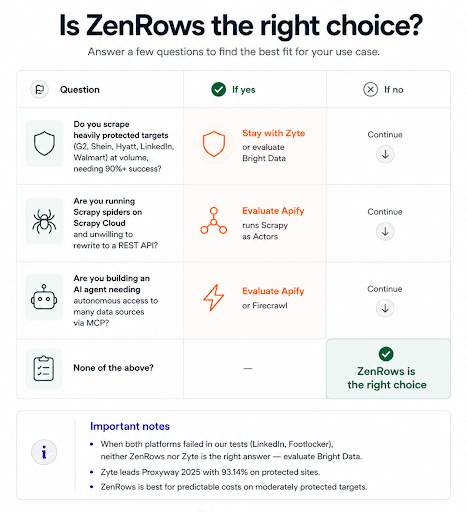
Target difficulty: If your pipeline depends on scraping LinkedIn, Walmart, G2, Shein, or Hyatt at volume and requires 90%+ success, Zyte API’s 93.14% Proxyway result, and the infrastructure behind it are built for exactly that workload.
Our own tests showed Zenrows achieving 88% on LinkedIn against Zyte's 0%, confirming LinkedIn is a hard target but one where Zenrows has a meaningful edge at default configuration. This confirms LinkedIn sits in the hardest tier of the web, where neither platform reaches production-grade success rates at standard concurrency.
Zenrows is the reliable choice for mainstream protected targets like Amazon, Glassdoor, Reuters, and Google SERP, where it returned 99%, 99%, 100%, and 87%, respectively, in our test. Zyte's edge is narrower: it is built for the hardest WAF-protected enterprise targets like Shein, Walmart, and G2, where raw success rate justifies the pricing tradeoff.
Scrapy pipelines: If your team runs a mature Scrapy pipeline on Scrapy Cloud and rewriting to a REST API endpoint is not on the roadmap, Zenrows is not the right move. Apify runs Scrapy spiders as Actors without requiring a rewrite, which makes it the natural landing spot for Scrapy-native teams looking to move off Scrapy Cloud specifically.
AI agent orchestration: If you are building an agent that needs autonomous, protocol-level access to many heterogeneous data sources, the use case goes beyond what a scraping API is designed to handle. Apify’s hosted MCP server exposes 23,000-plus actors as callable tools. Firecrawl’s /agent endpoint takes a plain-English prompt without requiring a URL. Both are built for this pattern. Zenrows has an MCP integration, but we’re still working on the breadth of coverage.
Other Zyte Alternatives Worth Knowing
Each tool below solves a specific problem. The verdicts are based on Proxyway 2025 (third-party benchmark), Scrapeway bi-weekly benchmarks, and published pricing.
Apify: The right choice for Scrapy Cloud migrators. Existing Scrapy spiders run as Actors without a rewrite, and the marketplace gives you access to 23,000 plus pre-built scrapers. Billing runs on Compute Units, RAM multiplied by runtime, which is harder to model in advance than a fixed multiplier table. For light workloads on simpler sites, it comes in below Zyte on cost.
ScraperAPI: The flat-rate option for teams whose data collection focuses on Amazon, Google SERPs, or Walmart without a sales call. The per-request pricing looks straightforward until you hit the domain multipliers: Amazon at 5x, Google at 25x, LinkedIn at 30x. The mechanism is similar to Zyte's tier system, with a narrower cost range. Proxyway 2025 (third-party benchmark) puts the success rate at 68.95%, so factor that in if your targets are heavily protected.
Bright Data: The right choice when success rate is the only criterion and budget is not a constraint. Proxyway 2025 (third-party benchmark) puts Bright Data at 98.44%, above Zyte, backed by a network of 150 million IPs across 195 countries. Entry starts around $499 a month, and enterprise contracts run into the thousands.
Firecrawl: Built for pipelines where the output feeds an LLM, RAG system, or AI agent rather than a database. Every URL returns a clean Markdown by default. The /agent endpoint accepts a plain-English prompt without requiring a URL. Pricing is a flat one credit per scrape with no tier multipliers. Not the right tool for production e-commerce or SERP scraping at scale.
ScrapingBee: The closest alternative to Zenrows on entry price. $49 a month gets you 250,000 credits with a similar multiplier structure for JavaScript rendering and premium proxies. Scrapeway's bi-weekly benchmarks put average success at 31% across 13 targets, a significant gap behind both Zenrows and Zyte. Oxylabs acquired ScrapingBee in January 2026.
Oxylabs: It sits between Zenrows and Zyte on raw success rate in Proxyway's December 2025 Web Scraping API (third-party benchmark), backed by a network of 100 million plus IPs. The right choice when the bottleneck is proxy quality, and your data engineers have the technical depth to work directly with the infrastructure layer.
Conclusion
Our tests returned 99% success on Amazon, 99% on Glassdoor (DataDome), 87% on Google SERP, 100% on Reuters, and 88% on LinkedIn. Across the protected targets that define most real-world anti-bot workloads, Zenrows consistently outperformed Zyte, finishing with a 96% average against Zyte's 65.3%.
Combined with pay-only-for-success billing and a transparent request multiplier system that teams can model in a spreadsheet before a job runs, Zenrows delivers higher predictability and lower operational risk, making it the strongest starting point for most scraping pipelines.
For teams scraping a mix of protected and standard targets such as Amazon, Glassdoor, Google SERP, and news sites, Zenrows offers the best balance of success rate, cost control, and pricing transparency. Its predictable billing model allows engineering teams to estimate costs before launching jobs rather than auditing them afterward.
Zyte still has advantages in specific scenarios. On IKEA it returned 99% against Zenrows' 95%, and its Proxyway 2025 benchmark of 93.14% on the 15 hardest WAF-protected enterprise sites confirms it leads on the absolute hardest targets at production concurrency. But for the workloads most teams actually run in production, Zenrows provides the more practical, predictable, and developer-friendly solution.
Frequent Questions
What is the best Zyte alternative for AI applications?
Firecrawl. It outputs clean Markdown by default, accepts plain-English prompts through its /agent endpoint, and connects directly to LLM and RAG pipelines without preprocessing. It is the Markdown-first option on this list designed around that output format from the ground up.
Why do developers look for Zyte alternatives in 2026?
Three reasons come up consistently: pricing predictability, support response time, and runtime fit. Zyte’s auto-assigned tier system makes monthly cost forecasting difficult at scale, standard plan support operates without a published response time SLA, and teams that do not run Scrapy-native pipelines often find Scrapy Cloud's conventions add overhead without adding value for their stack.
Is Zyte good for web scraping at scale?
On raw performance, yes. Zyte leads independent benchmarks at 93.14% success across 15 heavily protected sites at production concurrency, the strongest result in the industry according to Proxyway’s 2025 report. The challenge at scale is cost forecasting. Higher volume means more exposure to tier reclassification, and the range between your best and worst case is 123x.
What is the cheapest Zyte alternative?
ScrapingBee at $49 a month has the lowest entry price on this list. The practical constraint is a 31% average success rate across Scrapeway’s benchmark targets, which means a meaningful portion of requests do not return usable results. ScraperAPI and Zenrows both offer a better effective cost per successful request once the failure rate is factored in.
Can I use Zyte alternatives without coding?
Yes. Apify’s marketplace includes 23,000 plus pre-built scrapers that run through a point and click interface without requiring code. Firecrawl’s /agent endpoint accepts plain-English goals rather than URLs, which covers a wide range of extraction tasks without writing a scraper. Both are reasonable starting points for non-technical users.
Does any Zyte alternative support autonomous web extraction?
Firecrawl handles this most directly. Its /agent endpoint takes a goal rather than a URL and works out the extraction path from there. Apify supports multi-step autonomous workflows through its Actor system. Both require some configuration for complex tasks, but are the closest options on this list to fully autonomous extraction.
What happened to Scrapy Cloud?
It still exists within Zyte's platform as an integrated product, not a standalone service. Zyte has maintained Scrapy Cloud since acquiring Scrapy, and it remains a supported part of their lineup. Teams looking to move off Scrapy Cloud while keeping their existing spiders intact have mostly landed on Apify, which runs Scrapy spiders as Actors without requiring a rewrite.